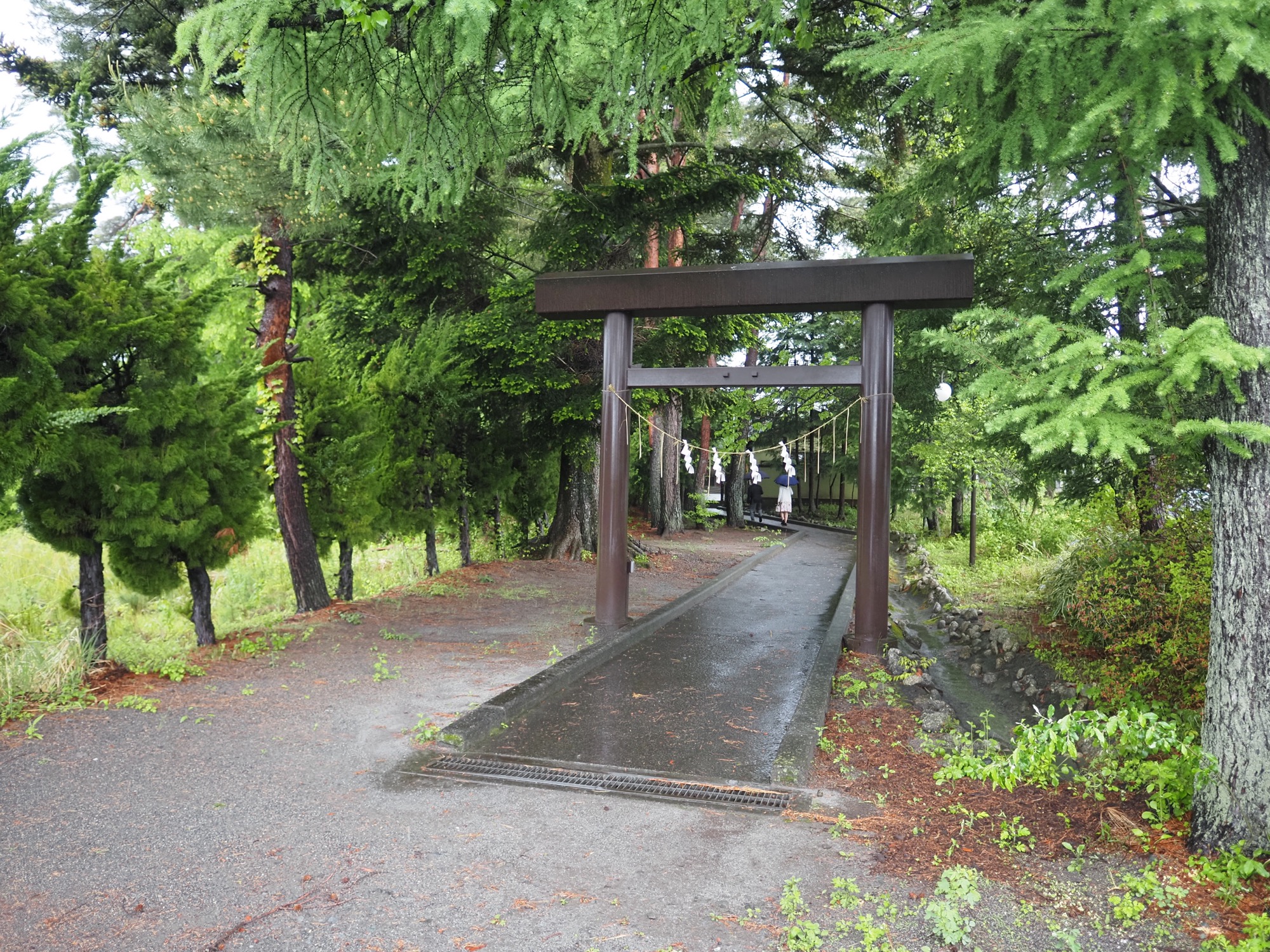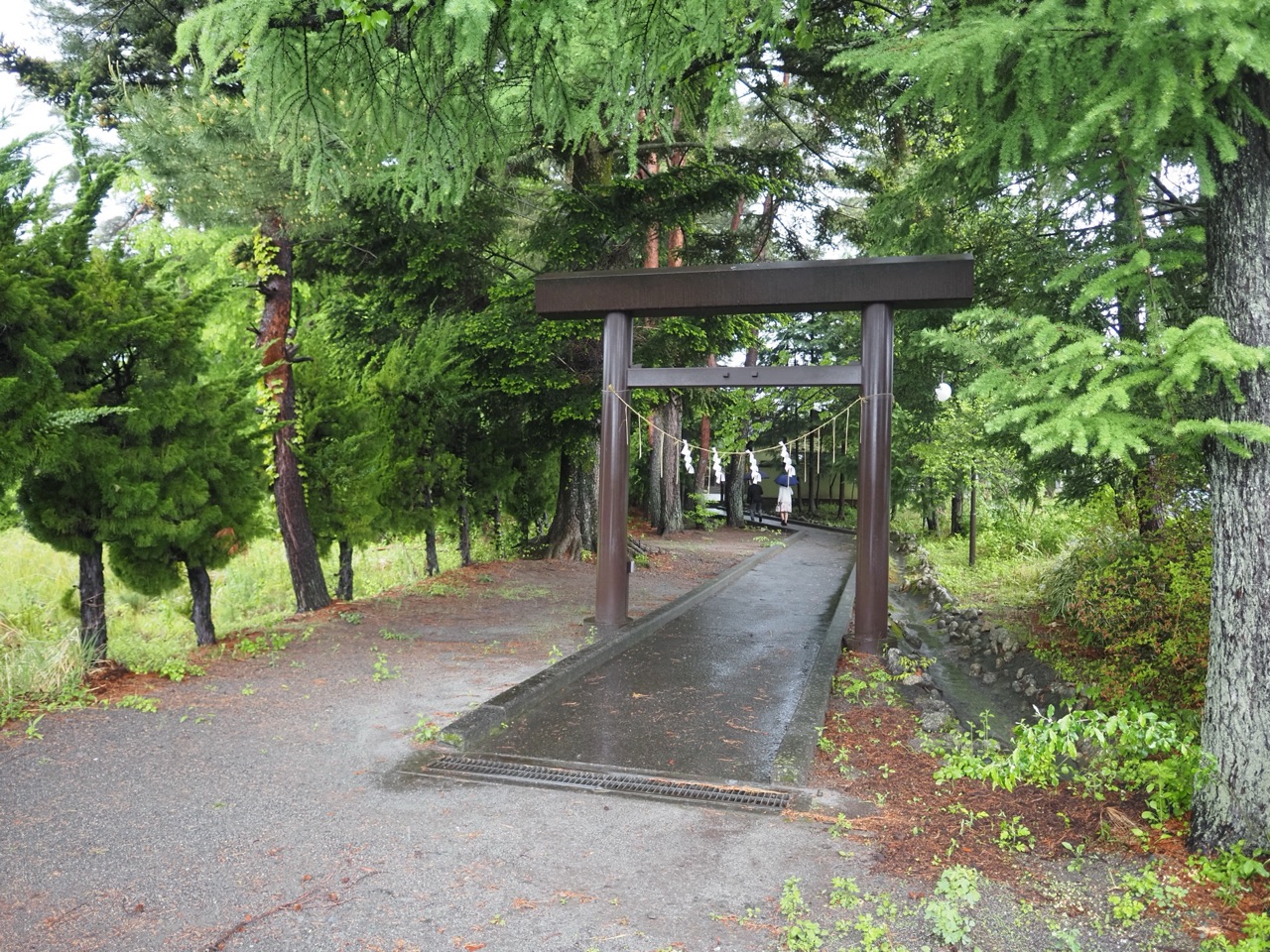
Komitake Shrine Satomiya
The satomiya — the village shrine — of Komitake Shrine, located in Kamiyoshida, Fujiyoshida City. Sited in the oshi pilgrim town of Kamiyoshida that served as the starting point of the Yoshida ascent, it has functioned as the spiritual anchor of Mt. Fuji pilgrimage, paired with the okumiya at the fifth station of Mt. Fuji.
The principal deity is Iwanaga-hime no Mikoto. She is the elder sister of Konohana-no-Sakuya-bime, the deity enshrined at Fujisan Hongū Sengen Taisha. Where the younger sister symbolises “the beauty and fragility of blossoms,” Iwanaga-hime stands for “the immutability and long life of stone.” In the Kojiki and Nihon Shoki, the two sisters appear together at their marriage to Ninigi no Mikoto; because Iwanaga-hime was sent back to her father, the lifespan of human beings became finite — a presence governing the providence of life itself.
In the religious world of Mt. Fuji, Iwanaga-hime has been venerated as the deity who guards the unyielding foundation of the mountain — the old Komitake volcano that underlies the present-day Mt. Fuji (the new Fuji). Geologically, the area around the fifth station is an unusual site where a portion of the older Komitake volcanic body lies exposed. In matters of faith too, it has been cherished as an “older mountain of the gods,” held within a context distinct from that of Sengen Taisha.
In the Edo period, the okumiya at the fifth station was widely known as Komitake Sekison Daigongen. The name arose from syncretism with the Sekison Gongen cult of Mt. Ōyama in Sagami Province; the tengu Tarōbō Gongen was enshrined there as a guardian of Mt. Fuji, bearing also the character of a deity of fire prevention. From around the Kyōhō era (the early eighteenth century), as the faith grew explosively, enormous sacred implements were dedicated in rivalry to display the deity’s majesty: a colossal axe some 3.6 metres long and weighing about four hundred kilograms, and a great sword some two metres in length — regarded as the instruments wielded by the god of Komitake, filling the confraternity members with awe, and remaining the symbols of the okumiya to this day. Standing at the “five-and-a-half” station of the Yoshida trail, the okumiya marked the junction between the summit route and the chūdō-meguri, the circuit around the mountain’s flank; pilgrims would invariably turn aside from the main path to worship there, offering heihaku and receiving brand-marks on their walking staffs. On the descent, those who had raced down the sand-run stopped here for the sunaharai — the ritual brushing-away of sand and defilement before returning to the world below.
The satomiya was established as a place of daily prayer for believers of the lowlands who could not directly ascend to the okumiya at the fifth station. With the explosive growth of the Fuji-kō confraternities from the mid-Edo period, the oshi quarter of Kamiyoshida came to function as the lodging town for kō members gathered from across Japan; the oshi, on receiving climbers into their lodges, are said to have first led them to worship at this satomiya to pray for a safe ascent. Ascending pilgrims would pray here for safe passage before setting out, and on returning would offer their thanks for a safe descent. The cluster of sacred sites around Eboshi Rock, associated with Jikigyō Miroku — the great restorer of the Fuji-kō — also lies nearby, making this a place of indispensable veneration for the confraternity members.
A geographic distinction is worth noting for anyone who has visited the modern “fifth station.” The terminus of the Fujisan Subaru Line — where buses deposit hundreds of thousands of tourists each year — sits at the historical funatsuguchi fifth station, the old trail from Kawaguchiko. This is not, strictly, the fifth station of the Yoshida trail. The true Yoshidaguchi fifth station lay lower on the mountain, near where the present-day Satogoya mountain hut now stands. From the Kawaguchiko side, Edo-period pilgrims climbed through the funatsuguchi approach to reach the go-gō-shaku (five-and-a-half station) of Komitake — the last distinctive landmark of their trail before joining the Yoshidaguchi route. A Shogunate ruling of 1810 formalised this convergence in economic terms: even those who had ascended from Funatsuguchi were required to pay their mountain toll to the Yoshidaguchi side.
Before the Subaru Line opened in 1964, reaching the okumiya required an ascent on foot, and the shrine’s priests brought its rites down to the pilgrims below. According to oral tradition passed down locally, the priests would descend from the okumiya at the five-and-a-half station, carrying an an — the lacquered ceremonial stand used in shrine ritual — to distribute protective ofuda to climbers on the Yoshidaguchi route around the Satogoya hut. Komitake was the last shrine of the Funatsuguchi approach, yet the priests crossed the ridge to the Yoshida trail, ensuring that pilgrims from either side of the mountain received the protection of the deity.
A modest wooden torii stands within a quiet grove. The approach beyond it is in no way grand, yet through the okumiya it joins the long thread of faith that reaches all the way to Fuji’s summit. As the spiritual core of the oshi town of Kamiyoshida — the place from which daily prayers travel to the sacred precincts of the peak — this shrine remains, quietly, exactly where it has always been.